
Signs of Mold in AC Vents in Fort Lauderdale Homes
Broward County averages more than 75 inches of rainfall a year, and Fort Lauderdale’s proximity to the Atlantic keeps relative humidity well above 70% for much of the calendar. That persistent moisture doesn’t just affect outdoor comfort, it works its way into the one system that circulates air through every room of your home: your ductwork. The questions below address what Fort Lauderdale homeowners actually ask when they suspect biological growth inside their ventilation systems.
What does mold inside AC vents actually look like?
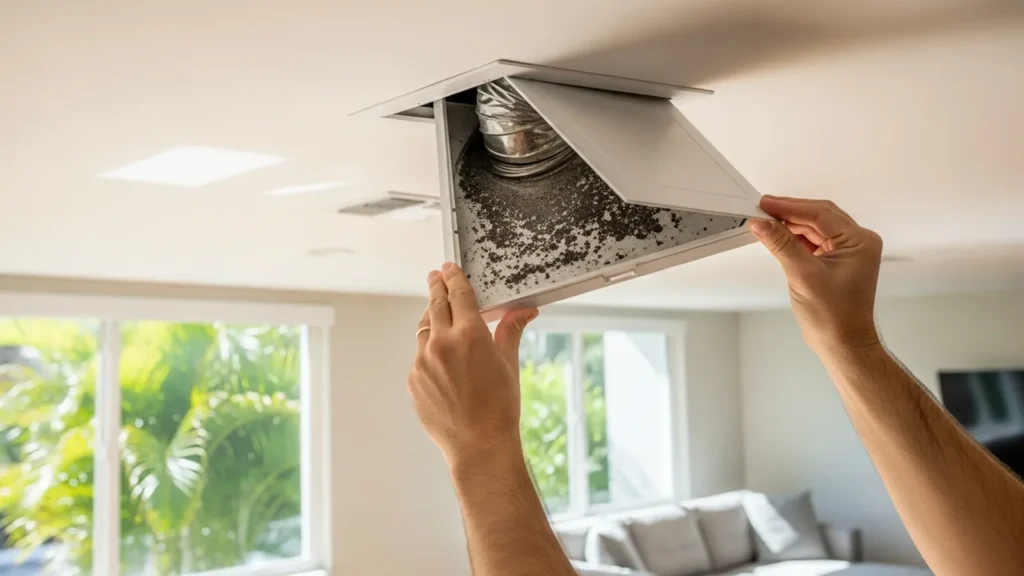
Mold in ductwork rarely announces itself with a dramatic wall of black fuzz. More often, you’ll notice irregular dark patches, green, gray, or brown, clustered near vent openings or on the inner lip of supply registers. Flex duct insulation can develop surface discoloration that looks almost like shadow until you get close. On metal duct sections, the growth sometimes appears as a fine powdery coating rather than the thick colonies people expect. If you remove a vent cover and see any irregular spotting on the duct walls within the first few inches, treat it seriously regardless of the color.
Why is Fort Lauderdale’s coastal climate a particular risk factor for duct mold?
Fort Lauderdale sits at sea level, flanked by the Intracoastal Waterway and the Atlantic Ocean. That geography means the air is almost always carrying significant moisture. When your air conditioner runs, the cold supply air inside the ducts meets warm, humid air that infiltrates through leaky connections or poorly sealed boot joints, a condensation scenario that creates standing moisture on duct surfaces. Homes built before the mid-1990s often used fiberglass duct board or older flex duct with degraded vapor barriers, both of which absorb and hold that moisture far longer than modern materials. The result is a surface that stays damp long enough for spores, which are always present in South Florida outdoor air, to colonize. Unlike drier inland climates, Fort Lauderdale doesn’t give ductwork a seasonal dry-out period.
What are the smell-based signs that something is growing in the vents?
Odor is usually the first signal homeowners notice. A musty, earthy smell that intensifies the moment the air handler kicks on is the most common description. Some people describe it as a wet cardboard or damp basement scent, which is unusual for South Florida homes that rarely have basements. The key diagnostic clue is timing: if the smell is strongest in the first few minutes after the system starts and then fades, the source is almost certainly inside the air distribution system rather than somewhere else in the house. A smell that gets worse as the system runs longer suggests the odor is being generated at a point where airflow is concentrated, such as near the air handler or in a main trunk line.
Can mold in ducts affect how the AC system performs?
Yes, and often in ways that are easy to misread as mechanical problems. Biological growth on evaporator coil surfaces or inside the air handler cabinet restricts airflow, forcing the blower motor to work harder for the same output. Homeowners sometimes notice that certain rooms feel less cool than others even though the thermostat is set normally, that uneven distribution can indicate a blockage or restriction in the supply side. A system that short-cycles (turns on and off more frequently than usual) or that seems to run constantly without reaching the set temperature may be struggling with a contaminated coil or heavily fouled duct interior. Before assuming a refrigerant or compressor issue, it’s worth having the duct system inspected. For a broader look at what professional service involves, see what a thorough vent cleaning inspection covers.
Are there health signals that suggest the vents may be the source?
This is where careful language matters. Duct contamination does not diagnose or treat any medical condition, and symptoms that concern you should always be evaluated by a physician. That said, homeowners often notice that dusty or musty air circulating through the home seems to coincide with increased sneezing, eye irritation, or a general sense that the indoor air feels heavy. These observations are worth mentioning to a doctor. From a home-environment standpoint, if the sensations seem to ease when windows are open or when you’re away from home for extended periods, that pattern is a reasonable prompt to have your indoor air quality and duct condition evaluated. A professional inspection can at least rule the duct system in or out as a contributing factor.
What visible clues around the vents point to a moisture problem?
Look at the ceiling or wall surface immediately surrounding each supply register. Discoloration, a ring of gray or yellowish staining, around the vent frame suggests condensation has been occurring at that point repeatedly. Paint that is bubbling, peeling, or feels soft near a register is another sign that moisture is migrating out of the duct system into the surrounding building material. On the vent cover itself, a fine dark residue that reappears within days of cleaning is a common indicator. That residue is sometimes described as “black dust” and is worth distinguishing from ordinary household dust: ordinary dust is light gray and fluffy; residue associated with biological growth tends to be darker, finer, and sticks to surfaces more readily. If you’re uncertain whether what you’re seeing warrants professional attention, understanding when duct cleaning is worth the investment can help you weigh the decision.
How does the age and construction of Fort Lauderdale homes affect mold risk in ducts?
Fort Lauderdale’s housing stock spans a wide range of eras, and the era of construction matters significantly for duct vulnerability. Homes built in the 1950s through 1970s, common in neighborhoods like Sailboat Bend, Progresso Village, and parts of Victoria Park, were often constructed with duct systems designed for window units that were later converted to central air. Those retrofitted systems frequently have undersized returns, poor sealing at boot connections, and duct materials that were never intended for the continuous-run demands of a South Florida AC system. Homes from the 1980s and early 1990s often used duct board, which absorbs moisture when vapor barriers fail. Newer construction post-2000 generally uses better-sealed flex duct and improved air handler cabinets, but even these systems develop problems when maintenance lapses, drain lines clog, or the system is oversized and short-cycles excessively. Regardless of build era, Fort Lauderdale’s humidity means no duct system is permanently immune to moisture accumulation.
What should you do if you find or suspect mold in your AC vents?
The first step is to avoid attempting to clean deep inside the duct system yourself. Surface wiping of a vent cover is reasonable maintenance, but using sprays or brushes inside the duct without proper containment can dislodge spores and push them further into the system or into living areas. A professional inspection will assess the extent of any contamination, identify the moisture source driving it (a leaking drain pan, a failed vapor barrier, an unsealed boot joint), and determine whether cleaning, sanitizing, or partial duct replacement is the appropriate response. Addressing the moisture source is just as important as cleaning the visible growth, without fixing the underlying cause, the same conditions will return. The professional air duct cleaning process for Fort Lauderdale homes is designed to address both the contamination and the conditions that allow it to persist. When you’re ready to find qualified help, choosing the right Fort Lauderdale duct cleaning company walks through what credentials and process to look for.
How often should Fort Lauderdale homeowners have their ducts inspected for moisture and biological growth?
General industry guidance suggests duct inspections every three to five years for most climates. In Fort Lauderdale, the combination of year-round AC use, persistent coastal humidity, and the biological load in South Florida’s outdoor air makes a shorter interval, closer to every two to three years, a more practical standard for most homes. Systems that have experienced a drain line overflow, a roof leak, or any event that introduced water into the air handler cabinet warrant inspection sooner, regardless of when the last service occurred. Keeping drain lines clear, changing filters on schedule, and monitoring the area around the air handler for moisture are the maintenance habits that extend the time between professional services. For specific strategies to reduce moisture accumulation in the system between cleanings, keeping Fort Lauderdale AC ducts dry between service visits covers the practical steps homeowners can take.
Mold in AC vents is a Fort Lauderdale-specific concern that gets worse when it goes unaddressed, not better. The coastal climate that makes this city worth living in is also the reason ductwork here faces conditions that most of the country never encounters. If any of the signs above match what you’re noticing at home, a professional inspection is the most reliable next step. Contact Express Air Duct Cleaning Fort Lauderdale to schedule a duct system assessment and get a clear picture of what’s actually happening inside your ventilation system.